Customize my trip


The Top Oaxaca Tours To Book In 2026
The best Oaxaca tours to book in 2026: Monte Albán ruins, mezcal palenques, Sunday markets and food walks. Picked by Rutopía's Oaxaca team.


Content
They highlight our work



Unique trips in Mexico.
Tailor made for you.
Request your tripTailor made for you.
Let a local guide help you plan your trip to Mexico
Start tailor-made tripThe best Oaxaca tours for 2026 are the ones built around what you actually came to Oaxaca for: a slow morning at a mezcal palenque in the Sierra Sur, an afternoon at a Zapotec weaving workshop in Teotitlán del Valle, a week in the highlands with a guide who has been working these valleys for fifteen years. Prices start around $850 per person for a 5-day guided experience and run to $3,500 and up for private multi-week routes. If you want a trip designed around your dates, start with our Oaxaca tours page.
Why Oaxaca in 2026
Oaxaca is the kind of place that splits travelers into two camps. One group visits for three days on the way to somewhere else and leaves saying it was nice. The other group stays for ten days and starts looking at flight prices to come back before they've packed. The difference is almost always depth, and depth in Oaxaca comes from the people who take you into it.
Three things are true about Oaxaca in 2026 that were not quite as true three years ago. First, Day of the Dead bookings are now filling 8 to 10 months out for the key October 28 to November 2 window; if that's your target, stop reading and go book. Second, the Sierra Norte and Pueblos Mancomunados community-ecotourism network has expanded its lodge capacity and English-language programming, which means the nature tour routes that used to require insider contacts are now more accessible. Third, mezcal tourism has matured enough that you can now tell a serious palenque experience from a tourism trap, and the mezcal tour guide we've built walks you through exactly that.
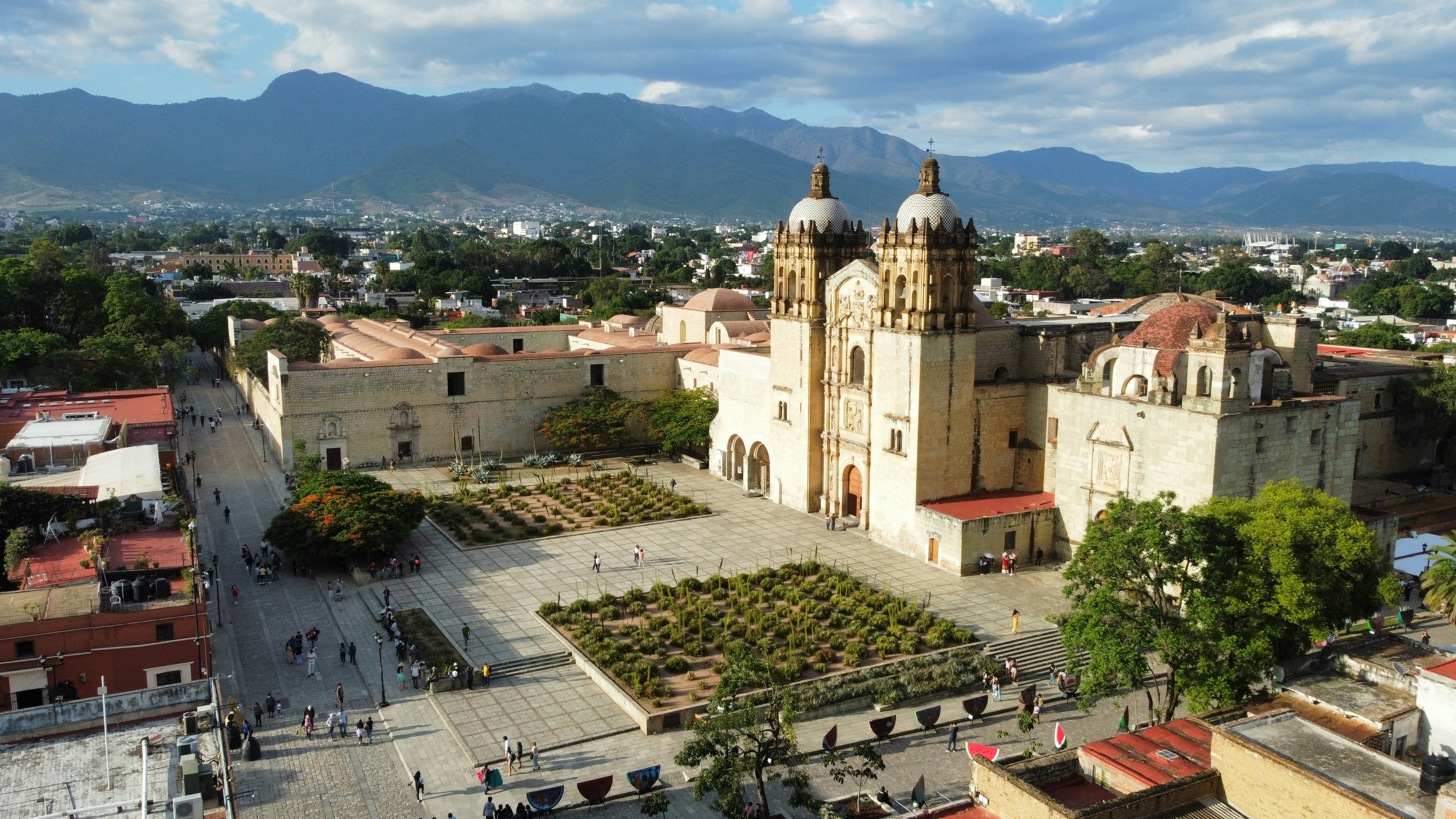
What hasn't changed: the food is extraordinary, the colonial center of Oaxaca City rewards slow walking, and the central valleys hold more history per square mile than almost anywhere in Mexico. For the broader Mexico context, our best Mexico tours roundup covers where Oaxaca sits next to Yucatán, Chiapas, and Mexico City as a destination pick.
The six tour types that cover almost every traveler
Most people who contact us about Oaxaca are actually describing one of six experiences. Knowing which one you are saves a lot of back-and-forth.
City and food tours anchor most first trips. Oaxaca City is walkable, dense with history, and genuinely one of the best food cities in the Americas. The question is format: a walking tour with a guide, a standalone food walk, or a private guide for the full day. Our Oaxaca city tour options guide breaks all three down with real pricing.
Local tip: We've found that choosing between a cooking class and a food tour often comes down to how travelers like to learn. Food tours tend to appeal to travelers who want to sample a wide variety of dishes and neighborhoods in a short amount of time, while cooking classes are usually better for those who enjoy a more hands-on experience. For travelers with significant cooking experience, private classes can sometimes offer a deeper experience because the pace and level of instruction can be tailored to their interests rather than the needs of a larger mixed-skill group.
Ruins and archaeology means, almost always, Monte Albán: the Zapotec hilltop city 10 km above the valley floor, a UNESCO World Heritage Site, and still one of the most underrated pre-Columbian sites in Mexico. Most visitors spend two to three hours there. Most wish they'd had a guide. The complete Monte Albán tour guide covers what to see, when to arrive, and why the first hour matters most.
Mezcal and distillery tours run from a 2-hour palenque visit bolted onto a cooking class to a full multi-day tour of the Sierra Sur's producing villages. Named producers, real terroir, and the kind of access you don't get by showing up with a cab driver. See the Oaxaca mezcal tour guide.
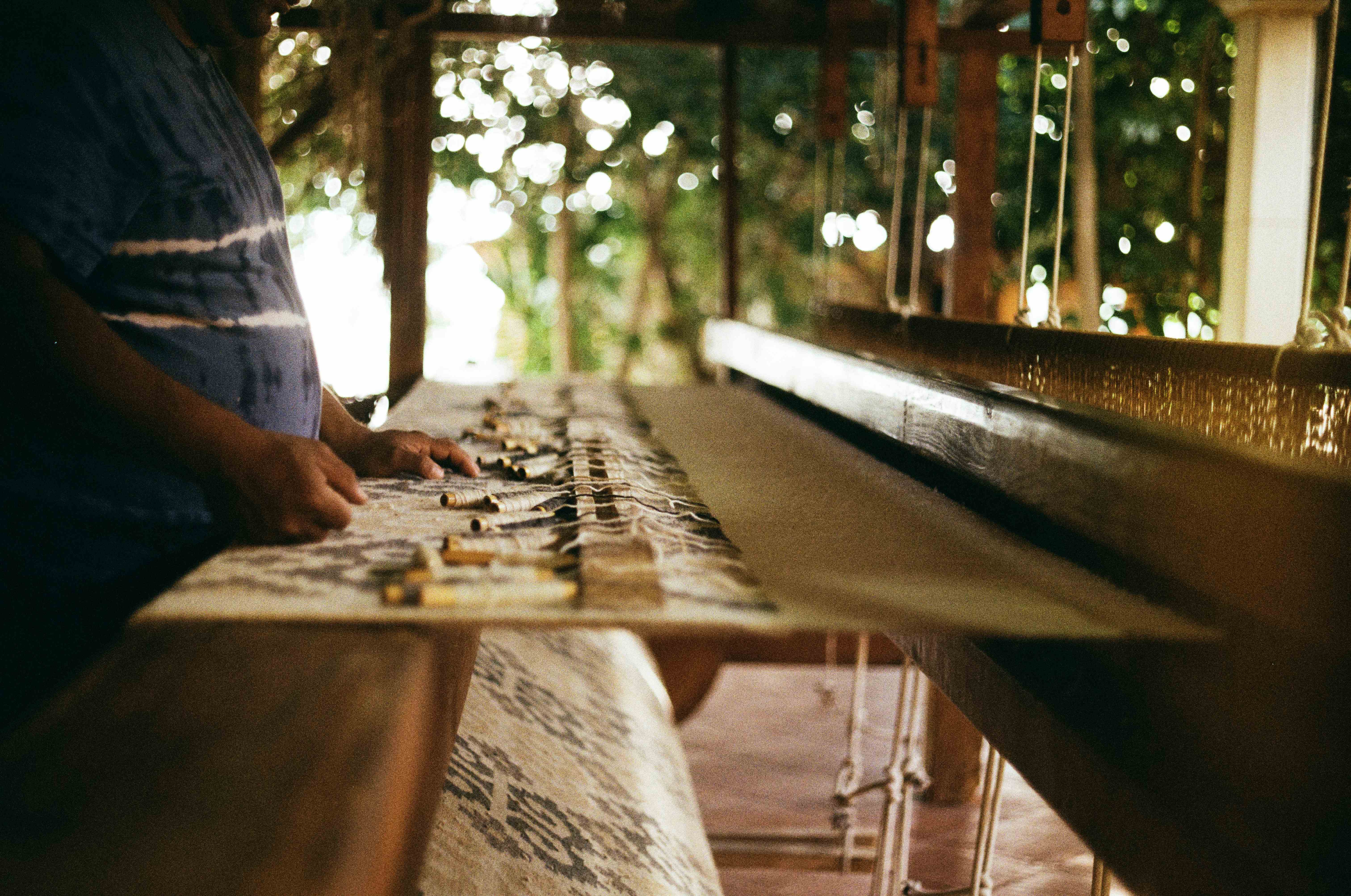
Artisan village circuits are what separate Oaxaca from every other Mexican city. Teotitlán del Valle for wool rugs dyed with cochineal, San Martín Tilcajete for alebrijes, Atzompa for green-glazed pottery. Each village is less than an hour from the capital by road. Done well, these visits fund the artisans directly. Done badly, you're buying machine-made imitations in a tourist shop. The artisan villages guide explains the difference.
Local tip: One of the biggest misconceptions about Oaxaca's artisan villages is that they can all be visited in a single rushed day without much difference between them. In reality, each village has its own traditions, techniques, and family histories. We've often found that travelers remember the conversations with artisans just as much as the products themselves. Allowing enough time for demonstrations, questions, and a shared meal can completely change the experience compared to simply stopping to shop.
Cooking classes and food tours overlap but are distinct. A cooking class means a kitchen, a market visit, hands-on preparation, and lunch you made yourself. A food tour is a route of stops, bites, and context. Both are excellent. The cooking class vs food tour comparison is worth reading before you choose.
Nature and Sierra routes cover the Pueblos Mancomunados cloud-forest treks, the Hierve el Agua petrified waterfalls, and the bioluminescent lagoon near Puerto Escondido. These require more planning than a city day, but they're the experiences that tend to dominate the trip report when travelers get home. The Hierve el Agua guide is the most-requested standalone read in this cluster.
A typical 5 or 7-day Oaxaca route
Five days is the minimum to leave feeling like you actually saw Oaxaca. Seven days is the sweet spot. Here's how we usually shape them.
5 days, Oaxaca City and central valleys: Day 1, arrive and walk the city, market, Santo Domingo, zócalo. Day 2, Monte Albán in the morning, artisan village circuit in the afternoon. Day 3, Teotitlán del Valle weaving workshop and Tlacolula Sunday market (if timing aligns). Day 4, mezcal palenque day in the Sierra Sur. Day 5, cooking class, fly out. Tight, but doable.
7 days, adding the sierra or the coast: Same base five days, then either two nights in the Pueblos Mancomunados for cloud-forest hiking and community lodges, or a 45-minute prop flight to Puerto Escondido for surf and coastal air. The Oaxaca itinerary packages guide has 5, 7, and 10-day templates with pacing notes.
For travelers combining Oaxaca with a broader Mexico trip: the classic pairings are Oaxaca plus Chiapas (10 to 14 days, overlaps in indigenous culture and archaeology) and Mexico City plus Oaxaca (7 to 10 days, strong food and history through-line). The Oaxaca and Chiapas itinerary and the Mexico City and Oaxaca plan lay out both options.
Local tip: One of the most common pieces of feedback we hear from travelers is that they wish they had allowed more time in Oaxaca. Many visitors arrive thinking of Oaxaca primarily as a city destination, then quickly discover that some of the region's most memorable experiences happen in the surrounding valleys, villages, and mountain communities. While five days is enough to experience the highlights, seven days often creates a much more comfortable pace and allows travelers to spend more time engaging with local hosts rather than moving quickly from one activity to the next.
What Oaxaca tours cost in 2026
Oaxaca is not a cheap destination by Mexican standards, and it is an exceptional value by international ones. Here is a working 2026 price map.
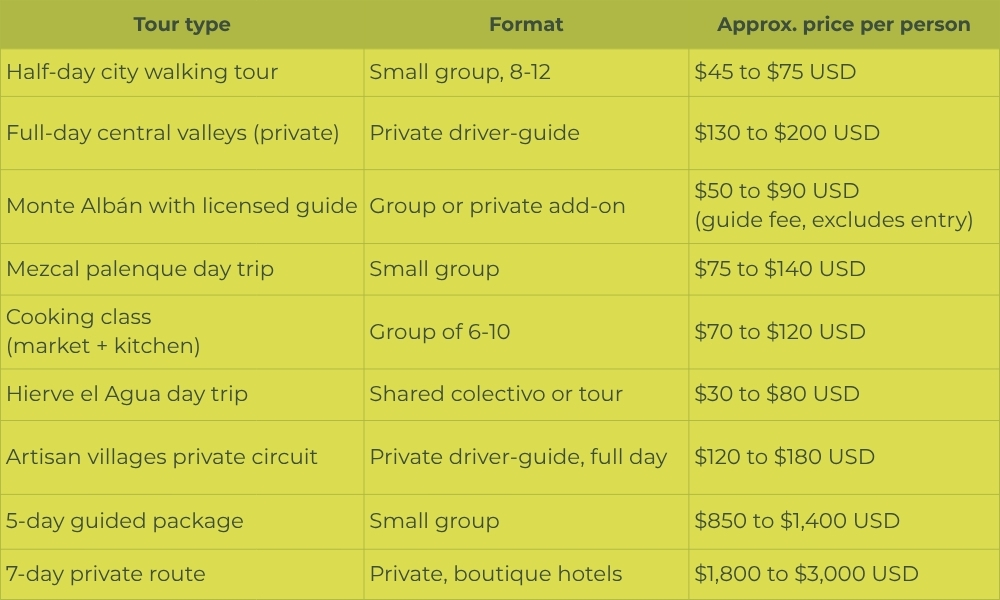
A private guide in Oaxaca runs roughly 2,500 to 4,000 MXN per day ($125 to $200 USD) depending on their experience and whether they're also driving. Entry to Monte Albán is 90 MXN ($4.50 USD). For a full breakdown of what drives pricing up and down, the Oaxaca private tours explainer runs the math in detail.
When to book and which season fits your trip
Oaxaca has two seasons that matter for planning: dry (November through May) and rainy (June through October). Dry season is easier logistically and more crowded. Rainy season brings afternoon storms, greener valleys, and prices that drop noticeably outside festival weeks.
Four booking windows to know:
Guelaguetza (late July): Oaxaca's biggest indigenous dance festival, held in the open-air amphitheater above the city. Tickets for the main show go on sale months before and disappear fast. Hotel rooms for the two big Mondays in July are gone by April at the latest.
Day of the Dead (October 28 to November 2): The single most sought-after event on the Oaxaca calendar. Cemetery visits in Xoxocotlán and Etla, marigold altars, all-night vigils. Accommodations and guided spots for this window are typically full by January or February for serious travelers. Book early, or go the week before or after.
Local tip: In practice, Day of the Dead is one of the few trips where booking "early" often means close to a year in advance. We regularly see travelers begin planning 10–12 months before travel to secure their preferred hotels and experiences. While it's still possible to plan later, availability becomes much more limited, especially for boutique accommodations and small-group cultural experiences during the October 28–November 2 period.
Christmas and New Year: Beautiful but expensive. Markets, Radish Night (Noche de Rábanos) on December 23, and festive streets. Prices spike and rooms are limited.
Shoulder months (February, March, September, October outside Day of the Dead): These are the months we often tell first-timers to aim for. Fewer crowds at Monte Albán, more availability at boutique hotels, better rates on private guides. The full seasonality breakdown goes month by month.
Is Oaxaca safe for tours in 2026
Oaxaca state is rated Level 2 (Exercise Increased Caution) by the U.S. State Department as of early 2026, which is the same advisory level as France, Germany, and most of Western Europe. Oaxaca City itself and the central valley tourist circuit are well-trafficked by travelers and generally low-risk for standard visitor activity.
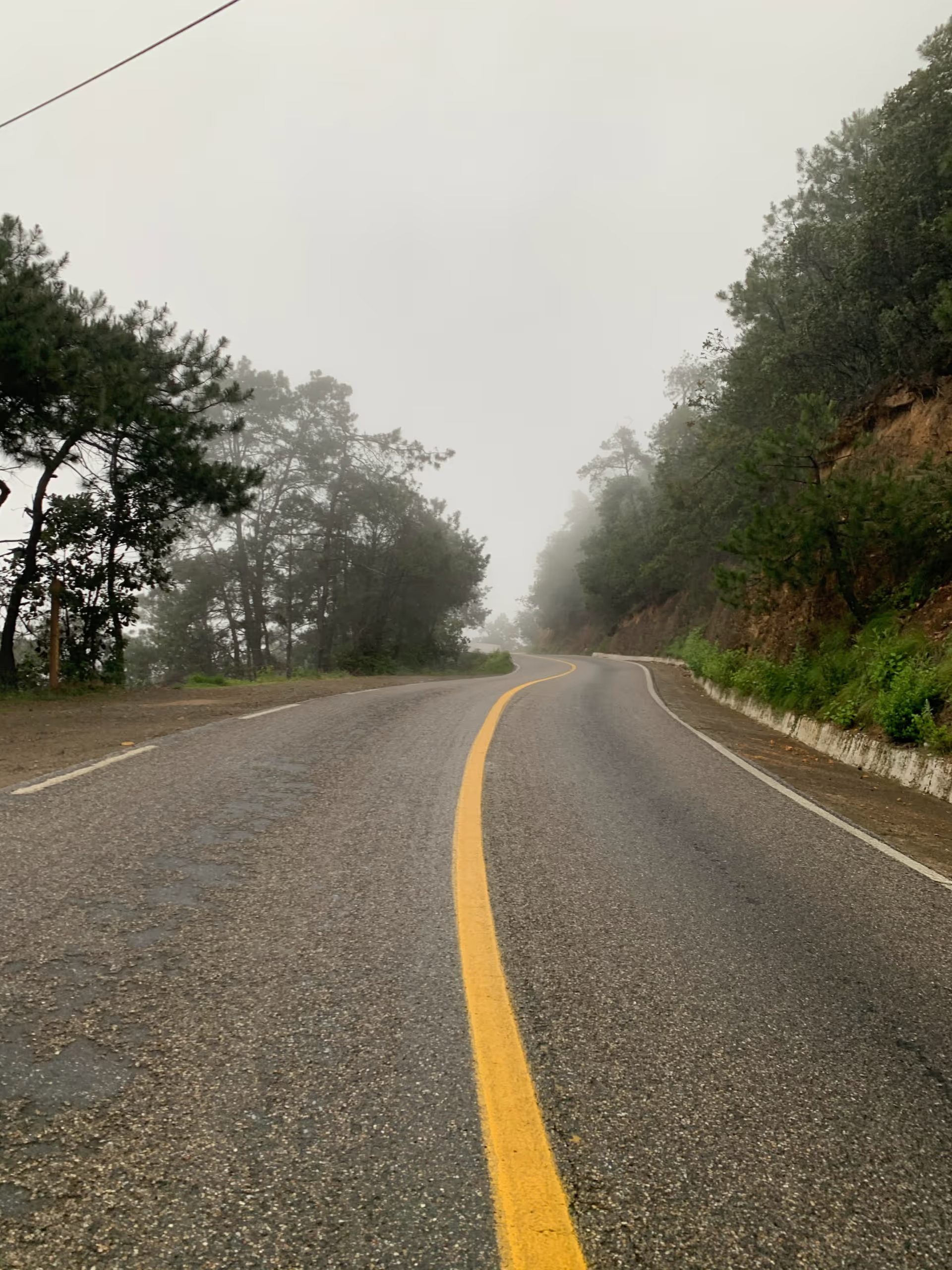
A few practical notes. The Sierra Juárez and some areas near the Isthmus have different risk profiles than the city and central valleys; any reputable operator routes around zones where they have concerns. Road conditions on the Oaxaca to Puerto Escondido highway (MEX-175) deserve respect: the route is mountain and winding, and night driving on it is not something we recommend. The Puerto Escondido to Oaxaca day-trip guide covers this honestly.
Local tip: From our experience at Rutopía, we have not encountered safety-related issues reported by travelers in Oaxaca, particularly in Oaxaca City and the central valleys where most itineraries take place. The destination tends to feel very calm and well-organized for visitors when trips are run with established local guides and trusted transport providers. The main considerations we focus on when planning trips are logistical rather than safety-related, especially timing, road conditions, and travel distances between rural communities, mountain regions, and the city.
How to choose an operator you can trust
Ask two questions before you book. First: who actually goes into the artisan villages with you, and do they have a relationship with the families there, or are they paying a middleman? Second: what happens to your trip if a road is blocked by a community protest, which does happen in Oaxaca, and happens more than the brochures admit?
The best operators in Oaxaca have roots in the place. They know which palenquero is actually worth visiting in any given month, which Sunday market is real and which has become a tourist loop, and where to take a traveler whose cooking class got rained out. Rutopía works with a local partner network that has been building these relationships for over a decade. Our Oaxaca tours page is the best place to start a conversation.
For couples specifically, the Oaxaca tours for couples guide picks the formats and stays that suit a slower, more immersive pace. For families, the Oaxaca family tours guide adjusts pacing for kids. And the beach extension guide covers how to add Puerto Escondido or the Oaxacan coast without breaking the pace of the highland trip.
Bookable tours and platforms we trust
A short list of well-regarded Oaxaca options across platforms. None of these are paid placements.
- Oaxaca Food Market and Cooking Class (Airbnb Experiences): Half-day with a local cook, includes Mercado 20 de Noviembre, about $65 to $95 USD per person.
- Monte Albán Private Tour with Licensed Archaeologist (Viator): Two to three hours, private format, roughly $80 to $130 USD for a group of two.
- Teotitlán Weaving Workshop with Master Weaver (GetYourGuide): Half to full day, direct with a family workshop, roughly $55 to $90 USD per person.
- Sierra Sur Mezcal Palenque Circuit (GetYourGuide): Full day, two to three producers, about $90 to $150 USD per person.
- Custom 7-Day Oaxaca Private Route (Rutopía): Built around your dates and interests, boutique hotel nights, private guide days. Pricing starts around $1,800 per person for two travelers.
FAQ
How many days do I need in Oaxaca? Five days is the floor if you want more than the city. Seven is where most travelers stop feeling rushed. Ten days opens up the sierra, the coast, and a real sense of the region.
What is the single best thing to do in Oaxaca? We get this question a lot, and the honest answer is that it depends on who you are. For food travelers, the cooking class with a market run beats everything. For history people, Monte Albán at 8:00 a.m. with a licensed archaeologist is the answer. For slow travelers, a full day in Teotitlán del Valle, lunch with a weaving family, and an afternoon mezcal tasting is hard to beat.
Can I combine Oaxaca with Chiapas in one trip? Yes, and it's one of the best trip shapes in Mexico. Allow 10 to 14 days minimum. The route goes Oaxaca City, fly or bus to San Cristóbal de las Casas, then cover Chiapas from there. The full route is in the Oaxaca and Chiapas itinerary plan.
Are Oaxaca tours appropriate for first-time Mexico visitors? Yes. Oaxaca City is compact, walkable, English-friendly in tourist areas, and has excellent boutique accommodation at every budget. It is, in our view, one of the two or three best first-Mexico destinations. The trade-off: it takes at least two visits to feel like you've scratched the surface.
What's the best time of year to go to Oaxaca? November through February for guaranteed dry weather and comfortable temperatures. October for Day of the Dead (if booked well ahead). July for Guelaguetza (if tickets available). The full booking-window breakdown goes deeper on each.
Do I need a private tour, or will group tours work? Group tours work fine for single days, market visits, and Monte Albán. For a multi-day trip shaped around specific interests, private is almost always worth the premium. The private tours explainer runs the cost comparison honestly.
Looking for more Mexico travel resources? Be sure to check out:
Written by
Design your trip to Mexico with a local travel designer. Unique activities and lodging, 100% tailor-made and stress-free.
.webp)
Related posts
Duration:
Trip duration
Days
Mexican Roads
Let's travel through the Mexican roads that take us to unimaginable heights, landscapes from other planets, and amazing architectures.
Read more
Duration:
Trip duration
Days
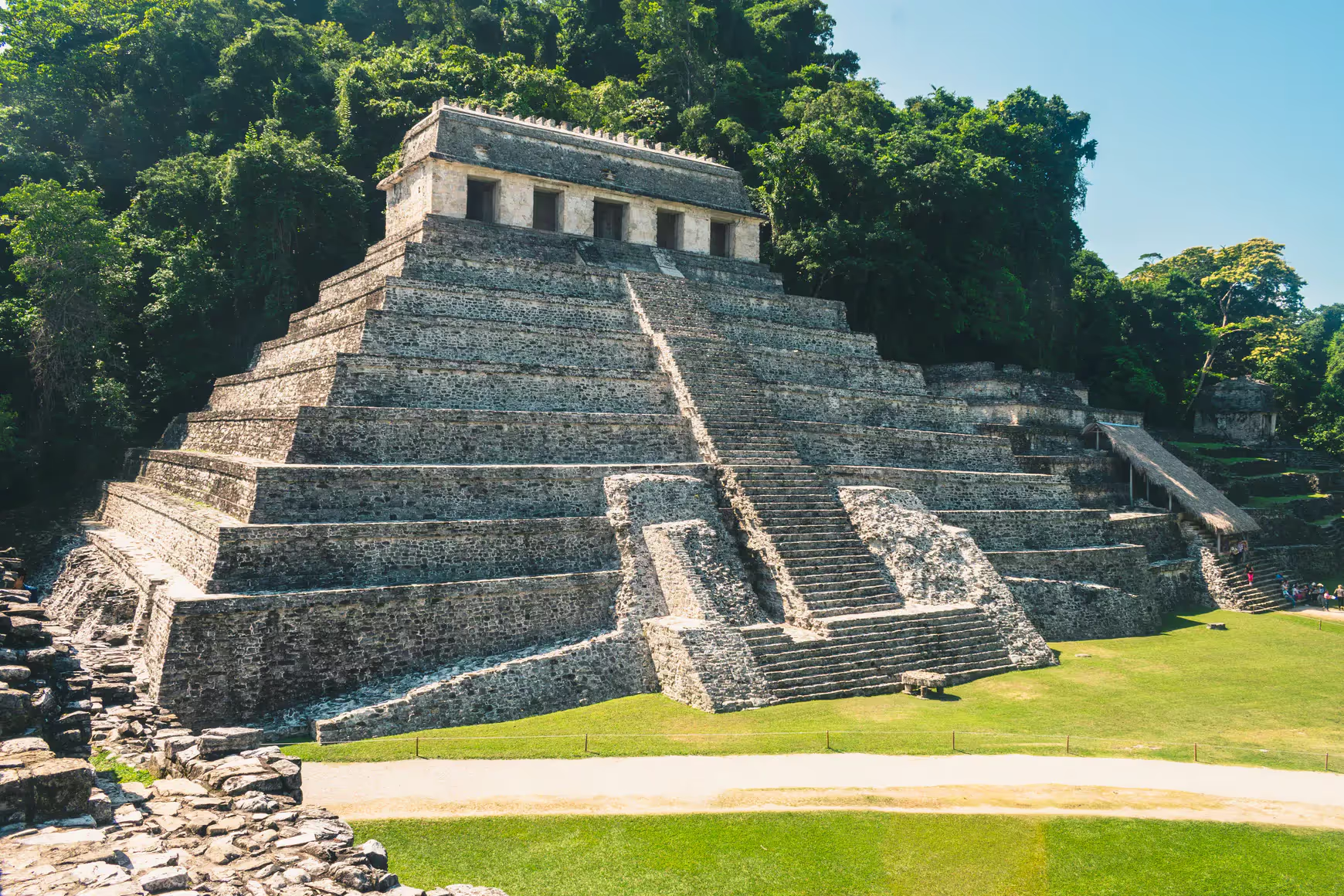
Palenque Guide
The heart of the Chiapas jungle is home to some amazing ruins. Here is a complete guide if you are looking for what to do in Palenque.
Read more
Join us on this
journey
Plan your trip with usjourney
Join our newsletter to stay up to date on features and releases.
Oups ! Une erreur s'est produite lors de l'envoi du formulaire.
Ready to experience the real Mexico?
Travel with local experts and get hangds-on supoort every step of the way... from planning to arrival.

Your Travel Companion in Mexico, 24/7
We're with you from arrival to departure via WhatsApp for anything you need.
Trusted by thousand of travelers with a 4.9 rating on Google