Customize my trip


How Mexico Sustainable Tourism Really Works In 2026
Mexico sustainable tourism done right: community-run lodges, fair-wage guides and regenerative routes that really fund conservation. Picks for 2026.


Content
They highlight our work



Unique trips in Mexico.
Tailor made for you.
Request your tripTailor made for you.
Let a local guide help you plan your trip to Mexico
Start tailor-made tripQuick summary: Mexico sustainable tourism at a glance
- Real sustainable tourism moves money, power, and decisions to the community hosting you, not to a foreign operator with a green logo.
- Community-run tourism operations in Mexico retain an estimated 60–85% of revenue locally, compared to 15–25% for conventional tours.
- Mexico has 182 federally protected natural areas, including 44 biosphere reserves (CONABIO), and community tourism is one of the most effective tools for keeping them intact.
- Fair-wage guides earn 900–1,600 MXN per day ($45–80 USD) for community routes; specialist bilingual guides earn 2,200–3,500 MXN per day ($110–175 USD).
- Community-run accommodation typically costs 600–1,400 MXN per night ($30–70 USD), often less than a mid-range chain hotel.
- Sustainable routes end-to-end are rarely cheaper than conventional ones, you're buying better distribution of where your money lands, not a discount.
- Self-drive travelers can reach most Oaxaca Sierra Norte and Yucatán inland community tourism sites without a tour operator for the journey itself.
- Rutopía holds B Corp certification and will name community partners, guide wages, and group-size caps on request.
Mexico sustainable tourism in 2026 lives or dies on one question: where does your money go? The real version is community-run lodges, fair-wage guides, and regenerative routes that redistribute income to the people who keep the place standing. Our Mexico trip team has spent years vetting these operators, and this guide shares what that process looks like. The Mexico tours hub for 2026 travel is a useful companion read for the regional context.
What sustainable tourism should mean in Mexico, past the greenwash
Too many operators use "sustainable" the way soft drinks use "natural": the word is printed, the practice is thin. A real sustainable tour moves money, power, and decision-making to the community hosting you. That means community-owned accommodation, local hiring at fair wages, food sourced within the watershed, limits on group sizes, and measurable reinvestment in land, water, or education.
The UN defines sustainable tourism loosely enough that any resort can claim it. The Mexican reality is narrower. Look for operators who will name their community partners, name the wages paid, and share how revenue flows. If they hedge, walk away. The best Mexico tours to book for 2026 travel hub explains why operator transparency is the single biggest lever you have as a traveler.

Pueblos Mancomunados, Sierra Norte: the model that works
Two hours north of Oaxaca City, eight Zapotec villages share one of Latin America's most-studied community-run ecotourism models. Pueblos Mancomunados has been operating since the mid-1990s and still owns its own cabins, trails, and guide cooperative. Revenue stays inside the eight villages and gets reinvested into forest management, trail upkeep, and basic services.
A typical three-day loop runs from Benito Juárez to Cuajimoloyas to Llano Grande with a community nature guide. Day rate is around $150 USD per person, plus 180 MXN per night for a shared cabin (about $9 USD). The cloud forest is quiet, the food is village-cooked, and the wage is set by the cooperative, not a foreign operator. Pair a Sierra Norte loop with city days in Oaxaca using the Oaxaca and Chiapas itinerary guide. The UN World Tourism Organization's Mexico coverage backs up the model's credentials.
At Rutopia, we offer a variety of packages designed to match different interests and travel styles. Most of our experiences are centered around hiking and nature adventures in the mountains, where travelers can enjoy panoramic views, suspension bridges, lush green trails, caves, waterfalls, and zipline activities.
Beyond outdoor adventures, guests can also immerse themselves in authentic cultural and gastronomic experiences with local communities. These include learning how to make traditional tamales, participating in a pan serrano baking workshop alongside a local baker, exploring medicinal plants with a tea tasting, discovering the importance of corn in Mexican culture, visiting local families, and joining culinary workshops focused on this ancestral ingredient.
Lacandón community tourism in Chiapas
The Selva Lacandona is the second-largest rainforest in the Americas after the Amazon. Small Lacandón Maya communities inside the Montes Azules Biosphere Reserve run their own lodges, guide services, and boat trips into the forest. The most-visited community, Lacanjá Chansayab, hosts a few family-run cabin operations where revenue stays local and forest monitoring is part of the job description.
Expect 600 to 900 MXN per night (about $30 to $45 USD) for a shared cabin with meals, plus 400 to 700 MXN per guided forest walk. Access is long: a three-hour drive from Palenque, which is the honest trade-off and why most tours skip it. That's also why what remains is still intact. UNESCO's entry on Palenque and the wider region gives useful context for the cultural weight of the area. National Geographic's Selva Lacandona coverage is also worth the read. Travelers looking to stitch a Lacandón stop into a route can use the best Mexico adventure tours to book in 2026 guide for the Usumacinta and Bonampak logistics.
At the Topché Jungle Lodge Ecotourism Center in Lacanjá, travelers can enjoy a variety of immersive experiences in the heart of the Chiapas jungle.
- One of the most authentic activities is the seed workshop, where members of the local Lacandon community collect natural seeds from the forest and transform them into handmade bracelets, necklaces, earrings, and other traditional crafts.
- For adventure seekers, the Lacantún River rafting experience offers an exciting way to explore the region’s wild landscapes while navigating the crystal-clear waters surrounded by dense jungle.
- Visitors can also join a guided jungle hike through the rainforest, leading to an ancient Maya site that has been entirely preserved and protected by the local community rather than by the national archaeological institute (INAH). The trail continues to a beautiful hidden waterfall where travelers can swim in a natural pool surrounded by lush tropical vegetation

Fair-wage guides: what to ask before booking
A fair wage in Mexico's guiding sector depends on region, but roughly: 900 to 1,600 MXN per full day ($45 to $80 USD) for community-level guides, and 2,200 to 3,500 MXN per day ($110 to $175 USD) for fully bilingual, specialist city or expedition guides. Below that range and you're looking at an operator taking too large a cut.
Three questions to ask any operator before you book:
- Are your guides employees, contractors, or members of a community cooperative?
- What percentage of the tour price goes directly to the guide and host community?
- Are the same guides working the same routes year after year, or rotated in and out?
Good operators answer all three without hedging. The how Mexico private tours work guide walks through why these questions separate the real outfits from the branding-first ones. For the eco-specific angle, see how to find real Mexico eco tours in 2026, and the Mexico cultural tours guide covers how to vet a cultural visit along the same lines.
How to vet a Mexico tour operator for real sustainability
Look for four specific markers, not vague claims:
- Named community partners on the website (not "local communities," but actual village names)
- Transparent wage policy (they should say, on request, what a guide earns per day)
- Group-size caps (small-group itineraries in sensitive areas should top out at 8 to 12)
- Certifications that mean something: Rainforest Alliance, B Corp, Travelife, or Mexico's own NMX-AA-133 norm for sustainable operations
Red flags: vague language about "giving back," no named partners, group sizes over 16 on a "community visit," or "all-inclusive sustainable" packaging. Cross-check the vacation packages guide and the guided itineraries guide for how sustainability should show up in an itinerary line-by-line. For the safety layer on community routes, see is Mexico safe for tours in 2026.
Pro tip: Open an operator's website and go straight to their About page and any itinerary page. Within two minutes you should be able to find: the names of at least two community partners, a statement on guide wages or fair compensation, and a named certification. If none of those three appear anywhere on the site, the sustainability claim is marketing copy, not a practice. Operators who are doing this right don't bury it, they lead with it, because it's genuinely what sets them apart.
Bookable sustainable tours and community stays
Four bookable options across the sustainability spectrum:
- Viator, Pueblos Mancomunados 2-Day Hike from Oaxaca City: small group, stays at community-run cabins. Around $280 USD per person.
- GetYourGuide, Sumidero Canyon Boat Tour with Indigenous Ecotourism Cooperative: small-group, community-operated, around $65 USD.
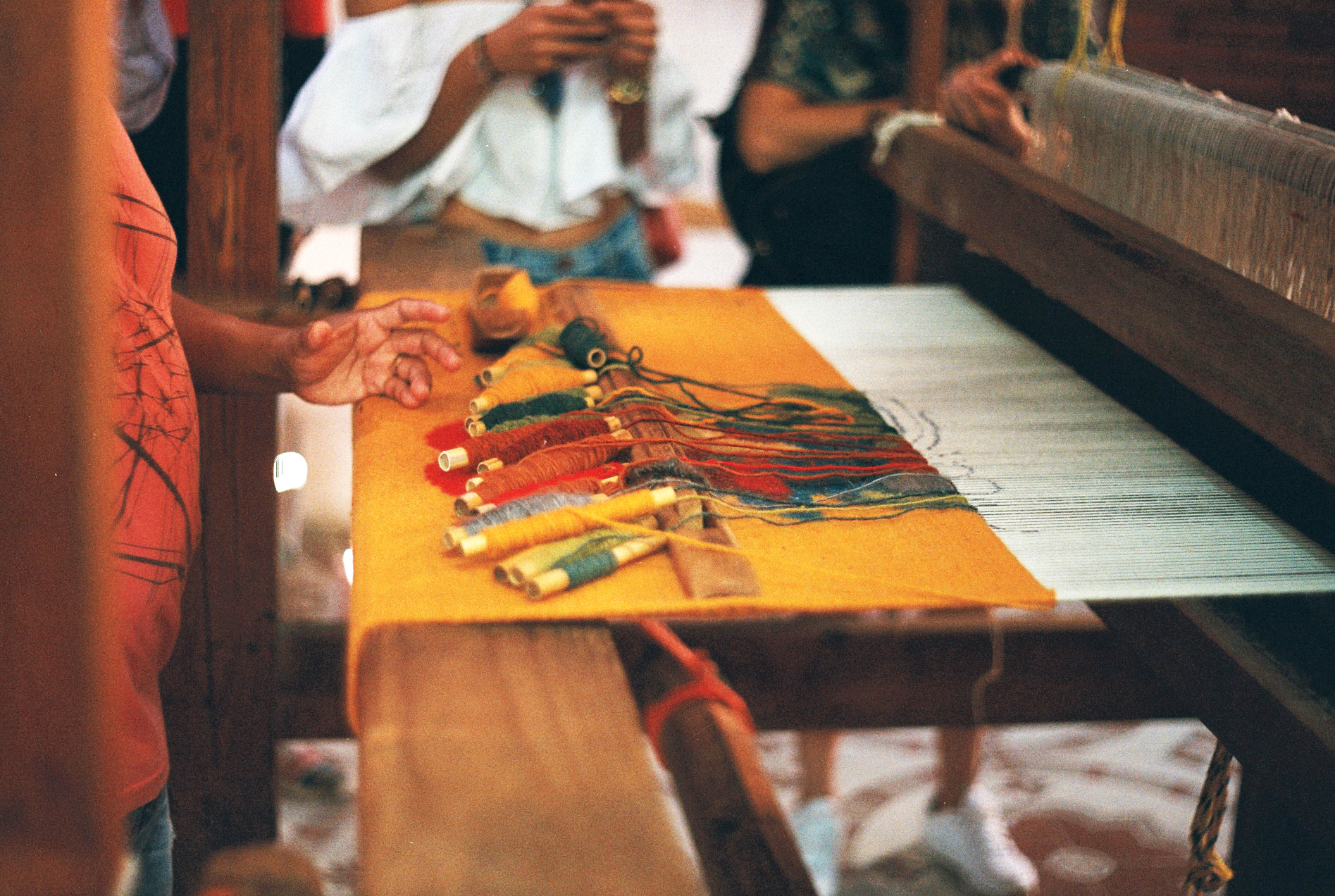
- Airbnb Experiences, Zapotec Weaving Workshop in Teotitlán with a Family Cooperative: half-day, 1,100 MXN per person (about $55 USD), dyes and fibers included.
- Rutopía, custom 10 to 14-day regenerative route through Oaxaca and Chiapas community partners: private, fair-wage guides, named community stays. From about $3,400 USD per person.
For how these compare to conventional tours on price, see how much Mexico tours cost in 2026. For first-timer framing, see the first-timers guide.
Cost comparison: sustainable vs. conventional
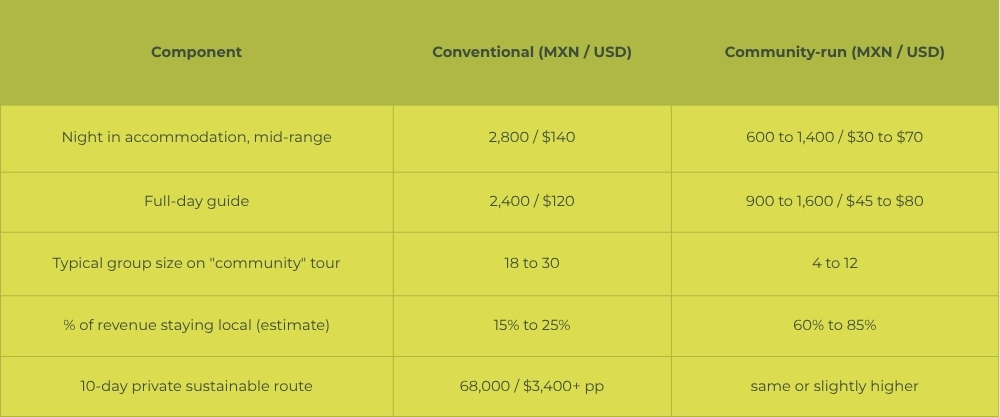
Sustainable routes are rarely cheaper than conventional ones end-to-end, because the fair-wage math has to add up. What you're buying is a better distribution of where your money lands, not a discount. It helps to weigh that trade-off against the other Mexico tour formats on offer for 2026, where price and structure vary widely.
Pro tip: One practical way to balance a sustainable trip budget is to book community-run lodges (where nightly rates are often lower than chain hotels) and pair them with independent overland transport, rental car or ADO bus, rather than private transfers between destinations. You keep the local revenue impact high at the lodges and guide level, where it matters most, and you spend less on logistics. The cost guide has a breakdown of where tour costs concentrate in each region.
Frequently asked questions
What's the difference between eco tourism and sustainable tourism in Mexico? Eco tourism focuses on nature and conservation; sustainable tourism also covers community ownership, fair wages, and cultural preservation. Most eco tours are sustainable, but not all sustainable tours are nature-focused. The Mexico eco tours guide goes deeper on the nature side.
How do I know if a "sustainable" operator is sustainable? Ask them to name community partners, guide wages, and group-size caps. Transparent answers are the sign. Evasive ones are the other sign.
Is sustainable tourism more expensive in Mexico? Often moderately more, rarely dramatically more. Community-run lodges often cost less per night than chain hotels; fair-wage guiding costs more per day than underpaid guiding. The balance usually lands within 10% to 20% of a conventional mid-range tour of the same length.
Which Mexico regions are best for sustainable tourism? Oaxaca's Sierra Norte and Central Valleys, Chiapas' Lacandón and Zinacantán regions, Yucatán's inland Maya communities, and parts of Veracruz and Chihuahua. Coastal resort zones are the hardest sell for real sustainability claims. Our CDMX and Yucatán tour itinerary covers how to route community-run cenote days into a standard Yucatán week. These same regions anchor many of the top Mexico tours worth booking in 2026.
Can self-drive travelers access community tourism in Mexico? Yes, and it's one of the most practical combinations. Pueblos Mancomunados in Oaxaca's Sierra Norte is reachable by rental car from Oaxaca City in under two hours on paved road. Most community tourism spots in Yucatán's inland cenote belt are also straightforward by car. You don't need a tour operator for the journey itself, the guide hire and activity fees you pay on arrival go directly to the cooperative. Pair rental car flexibility with the Oaxaca and Chiapas itinerary guide for routing ideas.
Does Rutopía hold any sustainability certifications? Yes. Rutopía is B Corp certified, which means our practices have been independently audited across community impact, environmental performance, and governance, not just claimed on a website. We'll also share our named community partners and guide wage policies on request before you book anything. The Mexico private tours guide explains more about how we structure our routes.
What is the NMX-AA-133 certification? It's Mexico's own national standard for sustainable tourism, issued through the federal environmental agency SEMARNAT. It covers criteria including water use, solid waste management, energy consumption, community benefit, and biodiversity protection. Not every legitimate sustainable operator holds it, some small cooperatives operate responsibly without the paperwork, but operators who do hold it have been through a meaningful audit process. It carries more weight than a generic "eco-friendly" self-label.
How should I tip guides and community hosts in Mexico? For community-level guides, 100 to 200 MXN per day ($5 to $10 USD) per person in your group is a reasonable starting point; more for exceptional guiding or a full-day backcountry route. For family-run lodge hosts, a tip equivalent to one night's stay split among the family is generous and appropriate. Cash in pesos is always preferred, it stays in the community immediately, without card processing fees.
What's the single most impactful thing a traveler can do for community tourism? Book directly with the community where possible, or through an operator who routes payment transparently to them. The difference between a community cooperative receiving 60% of your tour spend versus 15% is simply which intermediary you chose. Ask the question before you book: "How much of this price reaches the community?" The answer tells you everything.
Is sustainable tourism appropriate for families with children? Generally yes, with some route adjustments. Community lodges in Oaxaca and Yucatán are family-friendly; children tend to get a genuinely warm reception in Zapotec and Maya community settings. The harder community routes, multi-day forest treks in Lacandón or technical canyon walks, suit older kids and teenagers better. The Mexico family tours guide has specific picks for sustainable experiences that work across age ranges.
Looking for more Mexico travel resources? Be sure to check out:
Written by
Design your trip to Mexico with a local travel designer. Unique activities and lodging, 100% tailor-made and stress-free.
.webp)


Join us on this
journey
Plan your trip with usjourney
Join our newsletter to stay up to date on features and releases.
Oups ! Une erreur s'est produite lors de l'envoi du formulaire.
Ready to experience the real Mexico?
Travel with local experts and get hangds-on supoort every step of the way... from planning to arrival.


Your Travel Companion in Mexico, 24/7
We're with you from arrival to departure via WhatsApp for anything you need.
Trusted by thousand of travelers with a 4.9 rating on Google